
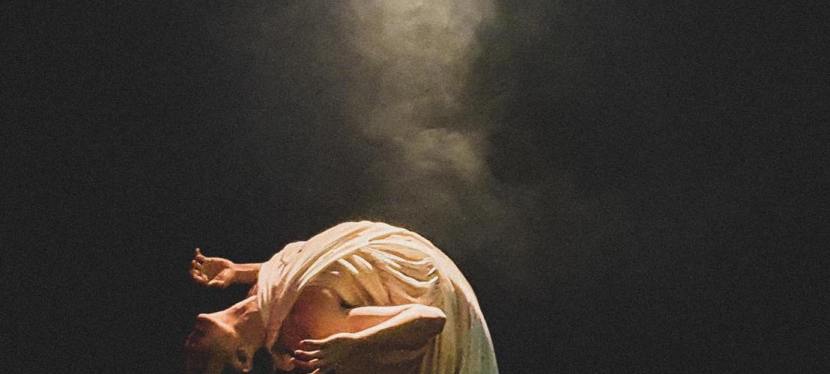
Learn more about local director, actor and dancer Thanupon Yindee (Golf) in his interview with Studio 88 artist-in-residence Ari Amari.
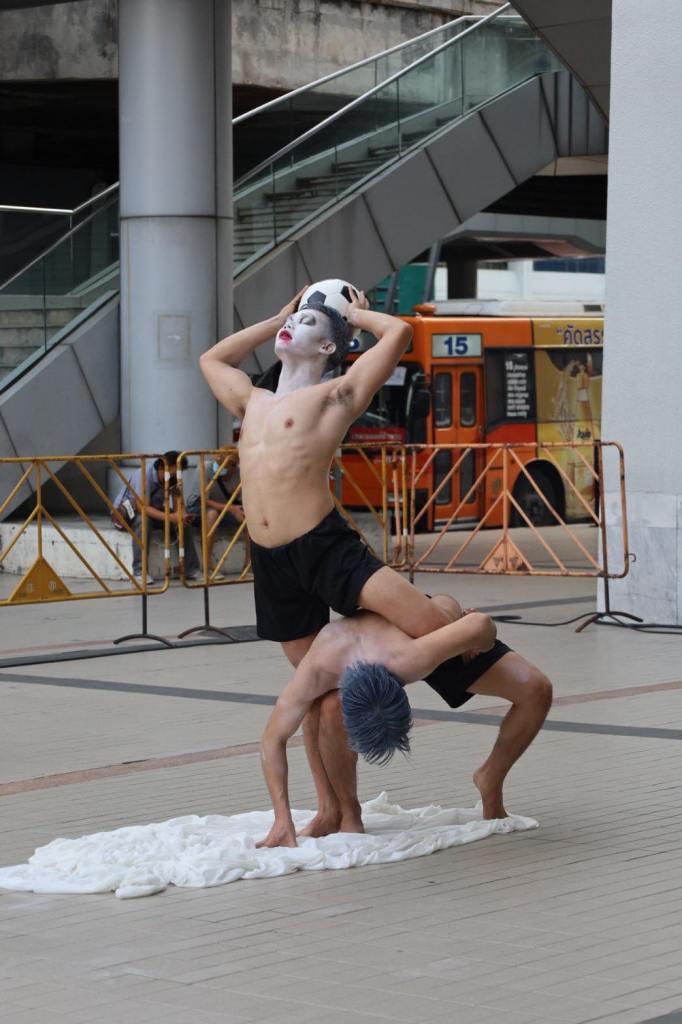
In March and April 2023 Swiss artist Ari Amari was an artist-in-residence at Studio 88. During their residency they spent some time with local director, actor and dancer Thanupon Yindee (Golf). Golf is a driving force behind Makhampom Theatre Group, a community theatre group in northern Thailand. He has worked on community theatre to raise awareness of children’s rights, to address stateless and ethnic minority rights in Northern Thailand and he has collaborated on international projects to produce contemporary circus and theatre. Golf is also an active member of the LGBTQIA+ community in Chiangmai.
During Ari’s time at Makhampom Theatre Group in Chang Dao, they sat down to have a chat with Golf.
Ari: How long have you been in performance arts?
Golf: Since I was in high school. Now I’m 32 years old. So, about 16 years.
Ari: What is your artwork about?
Golf: My artwork is about freedom, expression, free speech and equality. I talk about educational issues, human rights and environment issues.
There are always two elements I put in: the first is movement (I love human bodies in all diversity) and the second element is gender. Even if it’s subtle, I always talk about gender. I believe gender does matter every single second in your life. It shapes how you think and how people think.
Ari: How does being Queer influence your artistic work?
Golf: I came out when I was 13 years old. It was very hard for me to be a gay boy in a Catholic community and family. It was not easy to find someone that I could talk to. The only place I saw gay people was in soap operas in television programmes. But these were stereotyped gay characters, sissy boys which didn’t fit me. Also the actors played these feminine characters in a silly way to make fun of queer people. This made me feel that this topic is not on the front row of our society. I don’t like to be feminine in my daily life, but I like doing Drag and playing with femininity in theater.
So this influenced my artistic work in theater, because first I had to be acting loud and make fun of my Queerness, which made me feel lost. But at that time the people at Makhampom took me to the Bangkok theater festival. It was my first time in Bangkok, I was 17 years old. I saw a lot of diversity there, I saw the first gay couple in my life, and they were not like the gay stereotypes I saw in the soap opera. I also saw trans people for the first time and Lesbians, who not only looked like tomboys. I saw a lot of trans women with foreigner cis men. We say ladyboy here, but actually that is really harmful. It’s an insult for transwomen to be called ladyboy.
This experience in Bangkok has the biggest impact of my artistic work, the more choices the more decisions you can make. I finally had the feeling I fit somewhere.
Ari: So how do you identify? As a gay cis man or as a trans person?
Golf: I identify as a gay cis man. [“Cis” means that the gender that you’re assigned at birth is fitting to you while “trans” means, that the gender that you were assigned with at birth is not fitting.]
When I was young I thought being gay means I have to be a ladyboy and I have to cut my penis, work in a Cabaret show as a performer in Pattaya or in Bangkok. But I didn’t want to do that. I don’t want to have long hair in daily life, but I like to put on makeup and a wig for fun sometimes. But I never had someone to talk with to figure that out. So I was struggling a lot as a teenager.

Ari: Do you want to be an Idol for younger generations and help with their struggles as a queer person?
Golf: That is the second thing. First, I am doing it for myself. I don’t want to say this to be selfish, but everyone must find a way to be sure and explore themselves everyday. If what I am doing encourages and supports queer young people I am happy to help them and be a guidance for them and share my experience.
Ari: Is it established in Thailand that there are people who are intersex, non-binary or other forms of gender nonconforming like gender fluid, gender queer?
Golf: We were never educated about that. We always have to put everything in categories. Thai society never gave people a blank space for themselves to study about being non-binary. I think those people who fight for their gender identity, they can’t be silent, they can’t be tired. Because the other people are used to seeing only male and females. If you want to fight for your identity you need to speak up. Being silent and being just the way you feel you want to be, it’s not enough. You are born to fight. Because if you don’t fight today, they are coming to try to judge you, because they don’t understand you. But if you’re hard working and trying to explain it to 100 people, maybe just 5 will understand it. But it’s worth it. At least 5 will get you and can help the other 95 people to understand it.





Ari: You were in an artist residency in Switzerland. How was it different from Thailand?
Golf: I think it’s quite different being a citizen in those two countries. There is more equality. For example, everyone is using the same tram, with the same price. It doesn’t matter if your salary is high or low. I’ve seen a lot of poor people in Switzerland using the same bus as fancy looking people. Being a Thai artist in Switzerland I saw how much the state cares for all citizens
I know in your country you have lots of problems but you cannot compare that to us. Your problems might be annoying, but for us it’s not about something that annoys us, it’s about life. Some people die because they have nothing to eat.
Also in Switzerland you have a federal office for culture. Even big grocery stores are funding arts and giving opportunities to artists. Because the people go to galleries and concerts and theatre they know the value of art. There is a lot of competition for artists for sure, but you have possibilities. I saw in Zurich they used for only one production, 10 Mio. baht in three months, just 20 people participating in it. But in Thailand we have 10 Mio. baht for the whole art sector for one year. It’s so different.
Ari: Did you feel safe to be openly gay in Switzerland?
Golf: Pretty much, yes. But in Thailand, too. It’s pretty safe in Thailand.
If you are interested in meeting Golf and learning more about the experience of gender fluidity in Thailand, apply for the Gender – Fluid: Evolving Identities Chiangmai artist residency 13 May – 9 June 2024.
 Studio 88 Artist Residency